Sunday, April 26, 2015

Howl for Ghana

I saw generations of Americans grow beyond their skins
Dragging themselves down unlit streets looking for egg and bread
Who, poverty and unwashed, homely and happy, went to bed early in the last light of dusk, counting unseen stars, staring at tin roofs and considering hip life
Who bared their souls to Mohammed and saw nude angels racing in front of mosques, playing house and catch
Who passed through ambassadors homes with red tinted eyes hallucinating jobs
Who were expelled from spots for obscene and dancing like an idiot
Who covered their heads in the north and their knees everywhere, listening to the Advice through the years
Who drank herb afrik in cold air hotels, or ate street meat on unlit corners, cried or hugged their drunk night after night
With dreams, with drugs, with waking early, alcohol and cock and endless breasts
Incomparable deaf streets and cloudless skies with lightning leaping towards baobab at village end, illuminating sleeping forms and moments between
Bad weed solidities of homes, bush green tan burials, akpeteshie drunkenness along tamale road,  container store and pothead taxi ride lights out, sun and sun and sun roaring every month, always, rubbish chaos and bright non light of mine
Who paid tros for the endless ride from tamale to Holy Accra on diazepam until the noise of dagomba movies brought them down, shuddering mouth wracked and battered, bleak of brain and eye bleary
Who drowned in bottles of local at giddy pass, stumbled out and sat through stale beer all night at point seven, listening to chris brown on the television
Who talked, continously,  every minute there was another English speaker, from tso to tro to spot to Shoprite to accra rest to the airport
A whole army of americans, climbing up trees, off low stools, off taxis off hitched rides, out of latrines
Whole intellects forgotten in seven days and nights of running
Who snuck into nowhere Quiet burkina, collecting local currency and baguettes
Suffering malarial sweats and fevers of unknown origin and diarrhea of parasites in ma fati's bleak, unfurnished hut
Who wandered around and around in stations knowing where to go, but not how to get there, and left only broken hearts
Who lit cigarettes off matches matches matches, chain smoking to keep the fire going while rocketing towards dawn
Who studied Marx, chairman meow, islam, jesus, and capitalism because the cosmos had forgotten them in ghana


Saturday, September 20, 2014

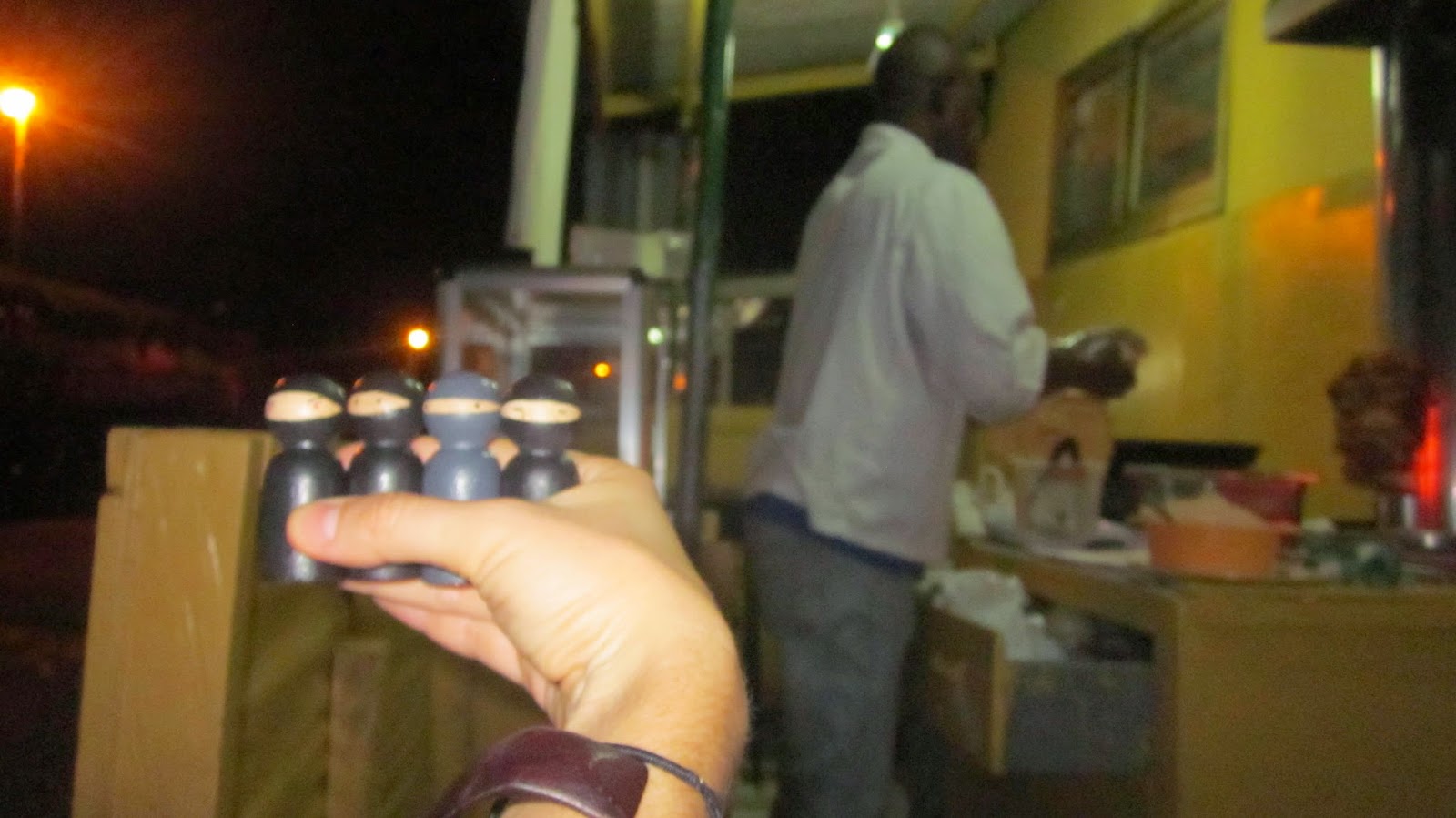
Adventures of a Ninja (part 2)


Hunting for a Dinosaur

Tired after climbing coconut trees
Silly ninjas, not the best place to buy your soda
Ninja sleeps it off after a night on the town. Other ninja is not amused
Ninjas go to nursery school


Wednesday, August 13, 2014

I get knocked down and I get up again

The line comes from a song by Chumba wumba called, oddly, thub-thumping. I’ve never understood the title; its airy chorus brags “pissing the night away” and lists beverages more likely to leave me vomiting the night away.
This is not that
This is the memory of a little boy riding on top of bags of charcoal to the hospital with his mother regularly; this is him hugging me; this is him following me down a path, quietly, until I notice and send him home. They’re well-worn memories; I try not to touch them too much for fear the contact will wear them away. This is his mother crying over the photo of him I gave her, how helpless I feel  next to her grief.
And this is the other little boy, running at me down bush paths, on a collision course with my kneecaps. It’s me, stepping aside and him forgiving me every time for not hugging him and holding any part of me-a finger, my purse strap-that he can reach. It’s me spending one night away and coming back to hear he has died. It’s going for a run and being bent in half by my grief, sobbing into a sweaty t-shirt just beyond where anyone can see me. It’s knowing that I never have a chance to love that little boy the way he deserved to be loved. I get knocked down…
…And I get up again. Today I got a ride to the taxi stand in Town and, before I got out, a man handed me 80 Ghana cedis. I don’t know why, I tried to demur but he was insistent. He didn’t ask for anything in return-not even my number. This morning a woman I’ve met twice told me her family would welcome me in to their home when I go to Kumasi later this week, and then sent me phone credit to offset the cost of me texting her.
I am knocked down by these deaths. I am knocked down by the level of grief I feel, the grief that I see. Yet every time I am knocked down I am picked back up again. I can’t take credit for it; it’s the generosity, the kindness, the love that comes from the people around me. This is how Ghana, how peace corps, how reality can knock me down, and this is how Ghana, how peace corps, how love can pick me up again.


Hamidu 2011- Aug 2, 2014
 Ibrahem: 2012-July 20, 2014

Kayayo

Northern Ghana was not developed when slave traders entered the country two centuries ago. By dint of their being on the coast, Accra, Tacoradi, and Cape Coast were points where Europe, and later America, came to build and fill ships with human cargo. According to “History of Africa”, the north was purposefully not developed by the British in order to ensure a constant stream of cheap labor when the farmers of the north suffered their dry season and moved south for work.
It has been over fifty years since Ghana gained her independence. It experienced the typical African growing pains; a harsh dictator, the bloody overthrowing, an economic descent into poverty, and has emerged into the twenty first century as a country that has experienced three elections without upset. The former Gold Coast has become the Gold Standard by which other African countries are weighed; a peaceful, development minded country whose south boasts hotels comfortable by western standards, a Shop Rite shopping center, and that bastion of development; obesity.
Once you pass through Kumasi, known through the country as being a site of robbery and the very worst in third world transportation, the country is unrecognizable. The north that the British are charged with never developing (but which most people have chosen to overlook) has one major paved road that bisects the regional capital, Tamale. The extreme poverty of the north is unique mostly for how widespread it is. It is not a few people in the north who are poor; it is a few people in the north who are not.
Because of this, many people in the north follow their need for income to the south. During dry season, the typical northern village loses a large chunk of their young women to work in the south, and you can hear the regional dialect Dagbani spoken frequently in Accra and Kumasi.
The disparity of wealth coupled with the fluctuations in the value of the cedi note combine to mean that goods are being sold for very low prices, and the relative wealth of the south remains contained. The young porters need housing, and many find it in refuse walled huts in what is known as “Soddom and Gamorah” in Accra. Those who cannot afford those prices can sleep on the street, and those who rightly fear for their safety on the street can find an older man, one with a home nearby, and accept his offer of a room in return for compliant sex. There is no shortage of these individuals.
Young women stencil their names on their arms with staining black ink so that, if they die in the south, their bodies will be returned to their families. Those that survive wear these marks into their adulthood with something like pride.  Those that survive frequently come home with new babies, with HIV or AIDS, with loss from malaria.

This is important because Ghana also leads the developing world in their low rate of HIV/AIDS, a trend that will not persist should the trend termed Kayayo (a Niger word meaning head porter) persist. What impacts one person has the power to impact us all. The success of Ghana gives hope to many African nations still in the adolescent process of Becoming, and its challenges reach farther than its own borders.


Tuesday, May 13, 2014

Monkeys

Edmond is small and wrinkled, but I am not fooled; I've seen the strength in wizened African men. Leading me easily through the jungle, I see my gauge of his strength is correct. My breath comes quickly, and I mop my damp brow with my damp handkerchief, while he tells an impeccable remembered history of the sanctuary. In 1827, he says, a fetish was spotted at the river, with four monkeys guarding it; two black and white, and two mona. It was a hunter that happened upon the fetish, and his presence initially scared away the naturally small monkeys. The hunter took the fetish home. Later the monkeys came to his house. They were not disruptive; they simply kept watch over the small, carved fetish. A priest was found, an he explained that the fetish was the child of the monkeys. The villagers could either keep it, and thus adopt the monkeys, or return it to the jungle and not be bothered by them again. They kept the fetish, and with it, made a vow not to kill anything in the jungle they lived in, regardless of whether the creature was monkey or snake, zebra or rat. As he finished the story, the branches began to shake. Water droplets whipped off of leaves and rained onto us. I am nearly certain one threw a stick at me. It was small, so I interpreted the gesture playfully. We bought bananas and fed them. The first few bananas I held too loosely, and rambunctious monkeys pulled them easily from my hand, to eat them a few feet away. Edmond showed me how to hold them tighter, and the next few monkeys carefully peeled back my fingers to get to the sweet fruit. One, distracted, sat holding my finger while he munched on the banana. His hands were leathery-soft. We ended with a visit to the monkey cemetery, where both monkeys and priests were laid to rest. Next to a wooden sign stating “young male Colobo. Buried 14-3-81” was another sign for a woman who had been the monkeys intermediary. The sign says she died at one hundred and twenty years old. Edmond whispers to me that she’d been a virgin, and had brought messages from the monkeys to the community. No one had replaced her since her death, he said. Shaking his head with disappointment, he explained “these days, it is hard to find a grown virgin”

Monastery

I am greeted by Brother Patrick when I enter. He is sitting on a low stool in a room in the shade, surrounded by bottled wines and jams. I ask how the avodado wine is. “I hope it is good” he says “I make it”. He leads me indoors and offers me coffee. I accept, not because I truly even want coffee, but because it is real coffee, not instant. Sitting in a room, generously called the library, I can see out into a garden. Flowering bushes grace the edges, and careful palm fronds betray it as a nursing garden. Somehow, that fits well here.

The brothers are quiet. They aren’t simply not voluble; their very presence draws some quiet within me. Their voices are even, measured. Their footfall is light. The breeze whispers as well, and a lone bee hushes around the edges of the room. The books are not plenty, but they are immediately impressive. Every encyclopedia brittanica is here, and books from “the Vision of God” to “100 Flowers”. Sipping my coffee and listening to the clock pass seconds by, I am aware that, in another life, I could be very happy here.

Thursday, February 20, 2014

I am the Lorax, I speak for the trees

I found a beautiful tree in my community. Instead of flowering, it makes these brightly colored puff balls. It's so amazing. It also is more than a little reminiscent of Dr Suess...did he spend time in Ghana? The kids like to eat the puff balls, but I have yet to try it. They just look weird. Behind me in the picture you can see a bunch of them still flowering-with the dry bush as a nice counterpoint.

Monday, February 10, 2014

A Weird Success

A huge part of being in Ghana has been learning lessons about myself and working to improve the way I work in the world. A big part of that is how I develop and maintain relationships, and what I expect to receive as return in my relationships.
Recently, a good friend of mine, Zeinab, came to me crying. She said that the headmistress at her school wouldn't let her take her BECE. I asked her why, but Zeinab said that the head just didn't like her. She said that it was possible for her to take the test at another school, but she didn't know how to get signed up. "Please come with me" she said, and because she's my closest friend in the village, I said yes.
We first went to the closest JHS to our village. We begged a ride on the main road, and alighted in Diare, at JHS A. It's at the southern tip of the town. We walked towards the school for only a minute before a young man, a teacher, joined us. He said we would have better luck at JHS B. We thanked him, and turned our feet that direction.
JHS B is at the northern tip of Diare. We tried to beg a ride, but the street was oddly empty at that time of morning, so we walked all the way through the village to the very northern point.
Waiting for the head there was easy, and we enjoyed a ball of banku. Or rather, I did. Poor Zeinab refused to even sit down. Her fingernails were bitten to the quick and one foot tapped a rhythm on the ground. She was a bundle of nerves. When the head arrived, I met with him in his office and explained the predicament. I was absolutely confident that he would sign up Zeinab for the test. Why not? She is a very smart girl.
But he told me he'd already sent in the list of students taking the test to GES. He thanked me for my time. He indicated the room full of students at old computers and told me he needed to start his lesson. I understood Zeinab's nervous tics.
She and I entered a truck heading south, and she ignored my attempts at conversation. They were very weak attempts. We sat and listened to the driver and mate speak rapid French and I wondered what it would be like to fail Zeinab. I wondered if she would cry.
We alighted in Pong Tamale, a town a bit south from our town, Tunayili. The first JHS was set back from the road only about half a mile, and we walked it with purpose. The round of greeting seemed to take forever, but finally we were able to talk to the headmaster. Sorry, he said almost immediately, I have already turned in my student list to GES. But try the other JHS, maybe they haven't.
At this point I couldn't even make eye contact with Zeinab. It didn't change my life if she didn't take this test, but it changed hers. She is seventeen and form three, and so, if everything went perfectly, she would take the test, score well, be accepted into an SHS, graduate from that, take the next important test, score well, and become...I don't know. A teacher? Sometimes she said she wanted to be a nurse. If she didn't take the test, she could anticipate getting married, probably to a local farmer, having children (lots and lots of children, the village women generally want ten) and then living the rest of her life walking the long hot stretch of land between her house and her farm. So even though this is where I would have given up if it was any other day, she and I walked to the other school.
It was much further from the road than the first had been, and it was forty sweaty and tired minutes before we reached it. A pleasant man named Alex-from-Accra invited us to sit in his chair under his tree while he tried phoning the head.
Unfortunately, the head was away. Alex-from-Accra told me we could either come back the next day (my shirt was stuck to my body, my legs jellied from walking) or we could try another school. Both options seemed bleak. But Alex-from-Accra informed me that he was good friends with the Nabogu head, and that if we went there and dropped his name, we would certainly be allowed to take the test. Pretending hope I didn't feel, Zeinab and I started back down the road.
We caught a ride in the back of a taxi to Nabogu, which is actually closer to my village than Pong Tamale is. From the boot, I jokingly asked a woman if I was invited to her take away containers. I must have looked pathetic, because she handed me a container over my protests and insisted we eat it.
In Nabogu, the head was away. His assistant was called from his home, though, and Elvis and I had a long conversation about Zeinab and what was best for her. Finally, wonderfully, Elvis agreed to sign Zeinab up to take the test with the Nabogu school. Elated and exhausted, she and I sat outside the school and ate rice from the take away container while the students stared.
Days went by, and one morning I was out talking with Amina, one of Zeinab's close friends. Amina told me that Zeinab had been heartbroken when she failed the test. What test, I asked. The pre-BECE test that the headmistress at her school had given her. She'd refused to sign up anyone who didn't pass the pre test, saying it was just a waste of their money.
So Zeinab had lied to me.
I spent a lot of time thinking about this. What I kept coming back to was that day that we spent around five hours walking and greeting and asking for favors from people we didn't know. I didn't just help Zeinab because I care about Zeinab, or even because I think she'd be a great teacher (nurse...?). I did it because I have the power to help people here, and when I use it, when I do things that wouldn't get accomplished without my presence, I feel really good. So that, to me, is a success. No matter what Zeinab scores on her test (or whether she never tells me she failed the pre-BECE exam).

Wednesday, November 27, 2013

Food (a blog from training)

I know someone who starts every meal with a prayer of appreciation for the hands that have touched her food before she did. Beginning at the farmer, the truck drivers and purchasers, the preparers and chefs, she makes her way through the chain of produce commerce before ending, neatly, with gratitude for the food in her hands. While I would never openly say it, except now because the internet is the great anonymizer, I found it rather silly. It was dozens of hands that had picked her food, miles that it had traveled, by the time it was something edible, it was incomprehensible to picture its beginning.
Yesterday I ate an egg while looking at a chicken. It was a well cooked egg, and I was extremely grateful for it. But I also know, looking at that chicken, that it was most likely her egg I was eating. Having that sensation is so rare in America (unless you are a farmer), but oddly gratifying. The egg had moved from the chicken to my host mother, from my host mother to my sandwich, and then to provide nourishment for my body.
Sometimes I go with my host brother to the fields where they grow sugarcane. He cuts it down and gives it to me. I’ve become adept at removing the green outside to chew the sweet center. I’ve drank sugar cane juices in America, but never sat and chewed on one that was grown feet from me.  I watched pineapple grow out of long bushes; I’d had no idea where they come from. Besides a vaguely formed idea of a pineapple tree, I assumed they appeared magically at the grocery store.
I don’t know the effect of becoming so separated from our food. Tellingly, our distance from our food is neither just physical or just emotional, but like all good conundrums, both. I feel a duality and connectedness I hadn’t known before; rain is both beautiful and life giving, the earth is both a stable landscape and a ceaseless provider, and my village is kind men and women, who have bent to the ground to provide the food that I receive.

Perhaps it is acceptable that we are so distanced from our food. I know nothing of the latrines the workers on farms in America use; I am unconcerned about whether they wash their hands. But the gratitude and connectedness that I am able to experience here is so different. Lately I’ve been sure, before meals, to bow my head and picture the path my food took to come to me, and be thankful.

Tuesday, November 19, 2013

The Small-Girl

I'm losing my ability to make light of ending. Death here is closer, like the sun, and just as indiscriminate and unforgiving. A girl with a face youthful and round grows a belly to match. I watched her expand from my safe distance. Last week I went to see her and found her belly sunken, and her eyes empty. They call you a small girl here until you've had your first baby. I wonder if you're still a small girl if your baby dies. I've never seen eyes grow so old so fast.
There are a thousand ways this place could kill. I won't let it. I promised my mom I'd come home. Being adventurous strikes me as the best way to survive. I'll climb trees, race down bush paths on bicycles and sit in the front of trotros. Make it a staring contest; I won't blink first, and my lorry always makes it home safely. Please come back, the letter from my nephew says. I will.
I want to relearn small children without heavy burdens. Sometimes I tire of babies with leathered feet and ancient eyes. Sometimes I think my soul is growing old. Sometimes I miss home.

Sometimes nothing feels more welcoming than riding the red dirt sand road home. Sometimes the sight of my village growing out of the bush is a symphony. Sometimes the only hard thing is being away from loved ones. Sometimes the hardest thing is falling desperately in love with sweat on my chest, dirt under my nails living know that one day, not even so far from now, I'll put down the mild mannered infant that sits in my arms like home and walk, knowingly, back down that red road out of this village forever. 

Thursday, July 25, 2013

Zeinab

Zeinab gets up in the morning while it’s still dark. Her mother is sleeping, young twins curved into her body. She is hungry; she eats what is left from last nights dinner, whatever sits in covered bowls. Zeinab sweeps the courtyard, careful not to wake her family. She piles the dust and trash into a large basin, and carries it across the road, jumping carefully to avoid gutters. She starts the fire, blowing on coals black as the night, and her mother stirs, half asleep, holding first one twin then another to her swollen breasts. Zeinab grabs her machete and leaves for the bush. She walks, barefoot, not noticing the unyielding ground below hardened callouses. She finds a small neem tree, leaves at the top reddened, slowly yellowing and turning green as the trunk thickens to roots. At the base she hits it with her machete, careful to hit the same space each time. The tree falls, and like a hunter skinning prey, she removes the branches until just the trunk is left. Finding a second tree is easy; neems litter the bush like trash. She piles the trunks on her head and returns home. The cool water makes her shiver, so she baths quickly; one twin is crying. One twin is always crying. Pulling on her school uniform, orange and brown, she plays with the baby until it coos with happiness. The other becomes jealous, begins to cry. Zeinabs mother sighs and ties her tightly to her back, letting the pressure of her body soothe the baby. Zeinab can hear the boy pounding a tin can in the distance, her call to get to school. She kisses the babies and dodges a swat from her mother. “Hurry up!” her mother yells, but Zeinab is already out the gate, tree trunks balanced on her head. “Run!” the teachers yell from their compound when they see her “fast! Yomyomo!” One hand to steady the trunks, trying not to trip on old shoes, she runs. She works hard, she learns fast. For four hours a day, Zeinab is a star. 

Fulani Rain

When the rains come, they don’t mess around. They are dust in skin and goats hiding from the wind. At the Fulani house, they’re preparing for the end of the world. The women hide under their tin roof, peeking out and finding excuses to brave the water, my smile mirrored in a dozen faces. The only one who truly hides is the man made real only by the frail bones holding on his loose clothing; otherwise he would slip from this world, leaving only silence where there had been the fluttering of the heavy pages of his Koran.

I knew all I had to do was get here. I knew once I got here I’d be welcomed. I knew they’d give me a seat out of the storm, an umbrella, nervous reverence, undeserved. I could be in any century. Should the world cease tomorrow and leave just this small village, they may only notice the new quiet of market. 

Ramadan

The teachers are playing football, running and kicking their new red and white ball. They haven’t eaten since four in the morning, have refused water; have even refused to swallow their own saliva, sending streams of liquid between parched lips. It’s Ramadan, and all but the smallest children spend the sunlit hours abstaining.
Jeff observed Ramadan. He was a college football player, and would pride himself on returning to his playing weight. He could still work, and well, running after angry kids despite occasionally going pale with the effort. It’s good to remember that all over the world, this community is tied into a greater community of Muslims fasting for their faith.
Still, children with arms thin as sticks and hanging from shirts that are always too big, regardless the size, they make me pause, just a little. So, when an old mother tells me she doesn’t fast because she is breastfeeding, well, I could kiss her.
I walk a fine line. Being an unmarried lesbian without a recognizable faith, a lot of what I do is smoothing out my rough edges with small white lies, which have the cumbersome habit of growing and turning grey.
Choosing not to fast is something I know I have to do, both for my physical and mental health. Explaining that not drinking water will make me sick lengthens the distance between me and the community, which wasn’t initially small.
Telling nursing mothers and small children its ok to eat may have consequences. Maybe next year. Maybe after they stop asking why I have no photos of my husband. Maybe when I’ve established praying in the mosque as a nice gesture, and not a sign of coming conversion.
The men on the field have muscles lit with sweat in the dripping sun. Their veins protrude, their lips are dry, but I hear no complaining; even children have lined up to chase the ball, kicking shoes from hard feet. There are cries of “mani! Mani!” on the field, each player vying for the ball, with thrilled laughter at each success and rambunctiousness and each missed kick. The women are pounding corn, cooking the meal they will end their fast on, and gossiping sweetly from house to house over short walls.

Rain is moving in quickly from the south. If I look left, the sky is an endless sweltering blue, but to the right are thunder clouds, dark as night with rain. The wind kicks up, pressing fear and excitement into my pores, drying the sweat I’ve spent the day accruing. Tonight I don’t want to sleep. I want to sit up while the teachers cook and eat the meal they’ve planned all day, and let the whole world melt away in a storm, rebirth disguised as annihilation.

Shia

I am just getting used to the village life. I’ve learned to keep my cell phone off, drew each hut in the village so I know the layout, and spend hours a day walking from hut to hut, bent at the waist like a movie maitre’d, greeting. From what I’ve seen, there is one English speaker. Her name is Karima, the same as the word for reading. Her hair is cut short for school, covered in what seems to be a winter scarf, transplanted from some chilly elsewhere. She ignores the boys who court her, telling me she must finish school before she marries. She adds that she hopes she gets an educated man so he won’t beat her. She is from bustling Tamale, and says she hates the village. She only comes back to visit Zeinab, her closest friend. When Zeinab tells me she will be a nurse, Karima nods so quickly her veil falls to the side “me too, I will be a nurse” she says. Zeinab seems pleased. She tells me that the Fulani, a nomadic tribe currently living outside of Tunaayili, have had a baby. We decide to visit. Fulani children tend to have bright eyes, set in beautiful triangular faces. They are lighter than their dagomba neighbors, with hair that curls long. Outside of the village sits a Baobab tree, flanked on all sides by neem trees. It seems to touch the sky, and the neems are so thick that the ground is always in shadow. It hums like a living being. I’m drawn, but Karima stops me. “Our ancestors live in that tree” She says. “The humming?” I ask “Shia” she says softly, like a prayer, “bees.” As drawn as I am to the brilliant baobab, I never feel quite right crossing the trunks of the neem trees that protect its roots. But I walk just on the other side, letting the hum pull me in as far as I dare. 

American letters and Dagomba charm

Inside the day seems too hot, sun baked like concrete courtyard. Outside is cool and undemanding. Azara and Drissa come over for alphabet lessons. Drissa wasn’t initially included, but his big love-me eyes and boney elbows tug my heart, and so I pass him a pen. He is behind his sister already. He can sing the alphabet-he loves the tune and I’ve caught him humming it while milking cows. But he can’t write the letters like she can, pen moving, fearlessly crooked Cs sweeping across her page; the lines are ignored. I let them. I remember the lines once feeling confining. He combines the letters he remembers, forming something like a complicated 8. I hold his small hand and trace, over and over, the shapes that I want to give him, the power of language I want him to feel. When I think of the letters left to teach them I am overwhelmed. I want nothing more than to give up. But when I trace an F on Azara’s hand, a reminder of the letter for after I’ve left, she impatiently takes the pen and, flawlessly, quickly, she draws it on the paper. Then I know I can’t stop yet. I grab her shoulders, squeal and babble pride at her, all Dagbani and American ebullience, and she smiles at me shyly, American letters and Dagomba charm.

Moto

Sometimes the sky seems too big, and sometimes a football pitch seems useless, like when there’s no ball, or shoes. Today I ran the pitch, marveling at the clouds rolling in and out like the high packed lorries on the main road. At some point, I don’t know when, we became motorbikes, bumping and vrooming and beeping into one another: a tall pale seliminga among small dark dagombas. At some point, I don’t know when, it stopped seeming so foreign here. Maybe it was when I gleefully held two watermelons like breasts in market and dagomba women smirked at batted my hands down. Perhaps when my first sentence became, not a greeting, but rather a request to eat the children, making yum yum noises as I tickle sweet soft bellies. People are the same everywhere, just as hope is, or hatred, or love. I love this place like fighting, with a ferocity borne of knowing I’ll leave, one day. Long after I stop pretending I came here to save them realize it was I that was saved. 

Simpa

He’s a normal guy in the village, a farmer. Usually he is dirty, covered in old clothes marred by his father’s farms dirt. But when the village dances a boisterous simpa, glowing yellow under the solar powered light in a village untouched by electricity, he is a hero. The children pull him from his home, ten children tugging each of his fingers, more pulling his sweat and dirt stained pants while he laughs and complies. Set up under the yellow light, modernity barely touching, glowing the crowns of their heads a halo hue, the drums begin centuries old rhythms. Light heartbeats in the night. “Salaam Salaam” he sings, and the children, in voices sweet with innocence reply “Salaam Alaikum”

Seliminga

When I first see my home, I am relieved, then immediately disappointed. Driving north, I watched the land become sparse, the manic rainforest greens of the south becoming subdued yellows in the dry north. The houses change, too. From concrete blocks with tin roofs come structures so basic the ground itself may have grown them. Round huts, orange red as the dirt, set low in to the ground and then topped with intricately woven thatch. It’s the Africa of magazines, of safaris and elephants, though I’m told that any big game has been hunted out of the open spaces.
My home is south Ghanaian excellence, out of place in the north; a reflective tin roof, concrete walls (four, not circular) and windows bearing smudged glass. I’ve seen rougher apartments in Denver. My home has a bathroom, complete with porcelain fixtures, and I stand in it, turning the faucet on and off in awe; running water.
My home is the only square one in my village, the only one made with concrete and not clay, the only one with doors that face east and west, instead of a careful north and south, to discourage the sun. It is also the only one to contain a seliminga, a white person. It’s the only one whose walls protect not just a person but a laptop, an iphone. It is the only one where shea butter is kept fresh in a Maxwell house coffee tin, the only one where a hand-thrown pot contains pens and stickers I initially bought to give as gifts, but now can’t bring myself to lose their hopefully bright colors, their American efficiency.
I recall my uncle scoffing at people who requested a village without electricity, in order to have a real peace corps experience. If you are in the Peace Corps, he’d said, then it’s the real experience.

Remembering that tempers my disappointment. I’d hoped to blend, I think, forgetting that I wear my differences on every inch of my skin. I think my community forgets, too. When people excitedly shout “Seliminga!” I am not the only one to look around, confused, to see who they’re talking about. “O ka seliminga” I’ve heard them explain “O nyela dagbang paga” She’s not a seliminga, she’s a dagoma woman. They paint my face with tribal markings, long liquid eyeliner lines down my cheeks, dots between my eyes. They ask to trade my American pants for their ankle length cloths. I can dress up and pretend, will speak the language and curse the children, because at night I come home to my four walls, my window and curtains, and watch the sun set while I hug my differences close.

The Baobab

There’s a tree, a powerful baobab. It’s over one hill next to the village. It is far enough away that you can pretend you are alone, but if you close your eyes and listen you can still hear the soft village noises; corn winnowed into open calabashes, the mimicked mechanical sounds of children playing motorbike and laughter, always laughter.
The bark is warmed by the sun, and soft, and touching it you can almost feel it breathing. You spend stolen moments there, pressed against it and feeling like a hug. One day, you find white cloth wrapped around the trunk, midway between two branches. Fearing that it’s marked for removal, you go to the community. You tell them that they cannot cut down the tree. They listen politely as you explain desertification, fragile eco system, any half remembered science to justify your concern.
A woman waits until you have finished and then places a hand gently on your arm. “The tree is a woman, and every night she comes out to dance. It’s getting cold; we've given her cloth to keep her warm.”

That night you dream of a woman, old and scarred and wrapped in a white cloth. In movements agile for her age she is dancing, eyes closed like she doesn't care who is watching, and smiling.